
Williamsburg County Court Records After Arrest
After a Williamsburg County arrest, the first public facts may come from detention or bond court, but the formal court record develops through the court system. A local arrest moves to booking at the Williamsburg County Detention Center when the person is held locally. Bond Court is held at the detention center at 9 am and 3 pm daily, including weekends and holidays. The next record trail depends on the level of charge, the court with jurisdiction, and whether the solicitor files or changes the charge.
Booking records and court records answer different questions. The jail record is about custody, intake, release, transfer, and sometimes the initial booking charge. The court record is about the case. It may show the filed charge, amended charge, hearing events, warrants, bond orders, plea, trial, dismissal, or disposition. For jail custody and booking details, use Williamsburg County jail inmate records. For booking photos, use Williamsburg County jail mugshots only where a photo or records request is actually available.
Search Williamsburg County Court Records
The main official channel is the South Carolina Judicial Branch case-records system. The state case-records search directory lists Williamsburg County in Judicial Circuit 3, county number 45, and links to the county case-record tool. The direct Williamsburg County Public Index endpoint is the practical starting point for court records after a jail arrest. The county Clerk of Court and Family Court page states that the office maintains accurate and accessible county records and court systems.
- Open the Williamsburg County Public Index or the state case-records directory.
- Search by defendant name, case number, citation, warrant number, or other case identifier when known.
- Open the matching case and compare party name, court, case type, and filed date.
- Review each charge, event, bond entry, warrant note, hearing, and disposition rather than relying on the booking charge alone.
The Public Index screenshot comes from the official Williamsburg County Public Index search endpoint.
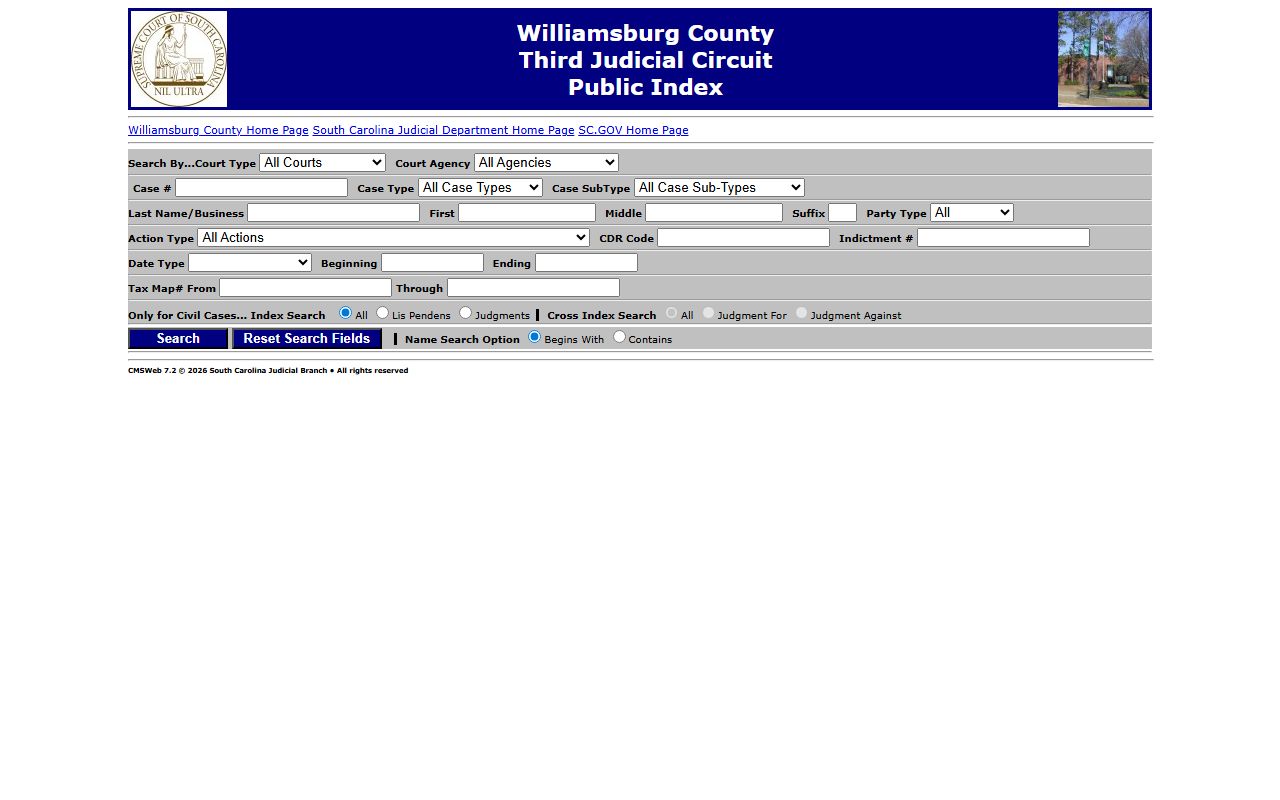
The image is used because the Public Index is the official court-search channel for filed charges and case events after a jail arrest.
Williamsburg County Public Index Fields
The Public Index endpoint was documented as the correct official channel, but exact field labels were only partially captured because command-line access to the page returned access limits. The safe approach is to describe the common official workflow as partial and browser-verified at use time. Do not treat a Public Index search as a live jail roster, and do not assume every arrest has a court case visible the same day.
| Field Label | Type | Required | Options / Format Notes |
|---|---|---|---|
| Case Number | Text | Optional or conditional | Use if known from citation, warrant, indictment, or court paperwork. Exact label should be verified in a browser. |
| Party Name | Text | Optional or conditional | Search by defendant name when the case number is unknown. Exact first-name and last-name labels should be browser-verified. |
| Court or Case Type | Dropdown or filter | Optional | Public Index may separate Common Pleas, General Sessions, Magistrate, and Family access depending on county setup. |
| Search or Submit | Button | Not applicable | Button wording should be verified on the live page. |
Williamsburg County Filed Charges
Magistrate Court handles lower-level criminal and traffic matters and initial processes. The county Criminal and Traffic page says magistrates have jurisdiction over offenses where punishment does not exceed a fine of $500 plus assessments and costs or imprisonment of 30 days. It also states that magistrates conduct preliminary hearings and may issue arrest and search warrants. More serious criminal prosecutions move through General Sessions, where the Third Judicial Circuit Solicitor handles the prosecution.
| Charging Document | Who Uses It | Role After Arrest |
|---|---|---|
| Complaint | Officer, court, or prosecutor process | Often starts or supports a lower-level criminal case after the alleged offense and booking. |
| Information | Prosecutor | Formal charging route used by the prosecuting office in eligible matters. |
| Indictment | Grand jury process | Common route for serious General Sessions charges after solicitor review. |
The Williamsburg County Solicitor page describes prosecution of General Sessions cases and juvenile Family Court cases. It also says the office works with law enforcement in preparing cases. That is why the court record may change after a jail arrest. The solicitor may file, amend, reduce, or dismiss charges as the case develops.
Williamsburg County Charge Status
Charge status is the part of a court record that tells whether an accusation is still active, changed, or resolved. It is different from the arrest itself. A booking charge can be broad or preliminary, while the Public Index case record may show a more precise charge, a later amendment, or a final disposition. Read every status line with the event date and court name.
| Status | Meaning in Court Records |
|---|---|
| Pending | The case or charge has not reached final disposition. |
| Amended | The prosecutor or court changed the charge language or charge level. |
| Reduced | The case moved to a lesser charge, often through plea or prosecutorial action. |
| Dismissed | The charge ended without a conviction on that charge. |
| Nolle prosequi | The prosecutor declined to proceed with that charge. |
| Bound over | The matter moved from a lower or preliminary stage toward General Sessions. |
Bond After Jail Arrest
Bond information often appears in both jail and court workflows. The Williamsburg County Bond Court page is unusually specific: bond court is held at the detention center at 9 am and 3 pm daily, including weekends and holidays. South Carolina law also provides the wider framework. S.C. Code Section 17-15-10 addresses release on recognizance for noncapital offenses unless the court finds appearance or safety concerns, and Section 17-15-20 describes bond conditions. Section 22-5-510 gives magistrates bail authority and includes the bond-hearing requirement for bailable offenses.
| Bond Type | How It Works |
|---|---|
| Personal recognizance | Release based on a promise to appear and comply with court conditions. |
| Appearance bond | Release conditioned on court appearance, remaining in the state if ordered, and good behavior. |
| Surety bond | Bond backed by a surety or bondsman where allowed by the court. |
| Cash bond | Cash posted when the court requires money to secure appearance. |
| No-bond hold | Custody continues because bond is denied, unavailable, or controlled by a higher court or another hold. |
Note: Another warrant, probation matter, federal hold, immigration detainer, or state-prison transfer can block release even when a local bond exists.
Warrants and Arrest Records
No official Williamsburg County online active-warrant search, sheriff warrant list, most-wanted database, or sheriff mobile app with a warrant lookup was located in the county and sheriff official source set. That does not mean no warrant exists. It means the public website reviewed does not expose a searchable warrant database. The county Magistrate Criminal and Traffic page confirms that magistrates may issue arrest warrants and search warrants, and those warrant events can lead to booking at the detention center.
For warrant-related court records after a jail arrest, search the Public Index for related cases by name or case number. Contact the issuing court or law-enforcement agency for status that cannot be confirmed online. Municipal matters may need a municipal court check. A person who may have an active warrant should understand the custody risk before appearing at a jail or court counter without legal advice.
Charges Convictions Expungement
Two comparisons matter for Williamsburg County court records after arrest. First, a charge is an accusation or filing, while a conviction is a court outcome after plea or verdict. Second, a record that is sealed or expunged may no longer be visible in the same way as an ordinary public case. South Carolina uses expungement routes for eligible records, and S.C. Code Section 17-22-910 says expungement applications are administered by the solicitor's office in each circuit for listed eligible records.
| Comparison | First Term | Second Term |
|---|---|---|
| Charge vs Conviction | A charge is an allegation or filed count. | A conviction is an outcome after guilty plea, verdict, or other qualifying adjudication. |
| Sealed vs Expunged | Sealed means public access is restricted by law or court order. | Expunged means eligible official records are destroyed or removed through the legal process. |
The solicitor directory identifies the Williamsburg County Solicitor office at 125 W Main Street in Kingstree, with public office hours Monday through Friday, 8:30 am to 5 pm, and the listed office phone 843-355-9321 ext. 7200. That office is the locally documented prosecution contact for General Sessions matters and the research-supported route for expungement administration through the circuit solicitor process.
Restricted Court Records After Arrest
South Carolina public access is broad, but not unlimited. South Carolina FOIA provides inspection and copying rights for public records, while Section 30-4-40 includes exemptions for some law-enforcement records, privacy interests, safety concerns, and active investigations. Juvenile matters, sealed charges, expunged records, certain victim information, and records tied to pending investigative work may be withheld, redacted, or handled through a different court channel.
Public Index results should also be read with timing in mind. A person may be booked before a case appears online. A charge may be amended after the first filing. A dismissal on one count may sit beside a plea on another. Court rosters can show upcoming settings through the South Carolina court roster directory, while the case record remains the stronger place to read the charge history and disposition.